Table of Contents
Introduction pollution effect oily skin
Living in a busy city with oily skin, I feel like my skin is constantly fighting a losing battle persistent shine, frequent breakouts, enlarged pores, and stubborn dark spots that never quite seem to fade. For the longest time, I blamed my diet, my stress levels, or just bad genetics. But the more I paid attention, the more I began to realize there was another significant factor I had been completely overlooking: the air I breathe and move through every single day.
Urban pollution is not just an environmental concern it’s a skin concern, and for men like me with oily skin, it’s a particularly brutal combination.
Men already produce significantly more sebum than women due to higher testosterone levels, meaning our pores are naturally more prone to congestion, breakouts, and surface buildup. Add a dense cocktail of airborne pollutants into the mix, and you have a recipe for accelerated skin damage that goes far deeper than just surface-level greasiness.
In this article, I want to share what I’ve learned about how pollution specifically impacts oily skin in men, why the combination is so problematic, and what can practically be done about it backed by a clear understanding of how our skin actually works.
Understanding Urban Pollution and What It Does to Skin
Before I get into the specifics of oily skin, I think it’s important to understand what urban pollution actually consists of, because I was genuinely surprised when I looked into it. It’s far more than just visible smog or dust. The air I walk through every day in the city is a complex, microscopic mixture that includes:
- Particulate matter (PM2.5 and PM10) : tiny particles from vehicle exhaust, construction, and industrial activity
- Nitrogen dioxide (NO2) : a gas produced mainly by motor vehicles
- Ozone (O3) : formed when sunlight reacts with other pollutants
- Heavy metals : including lead and cadmium, found in industrial emissions
- Polycyclic aromatic hydrocarbons (PAHs) : released from burning fossil fuels
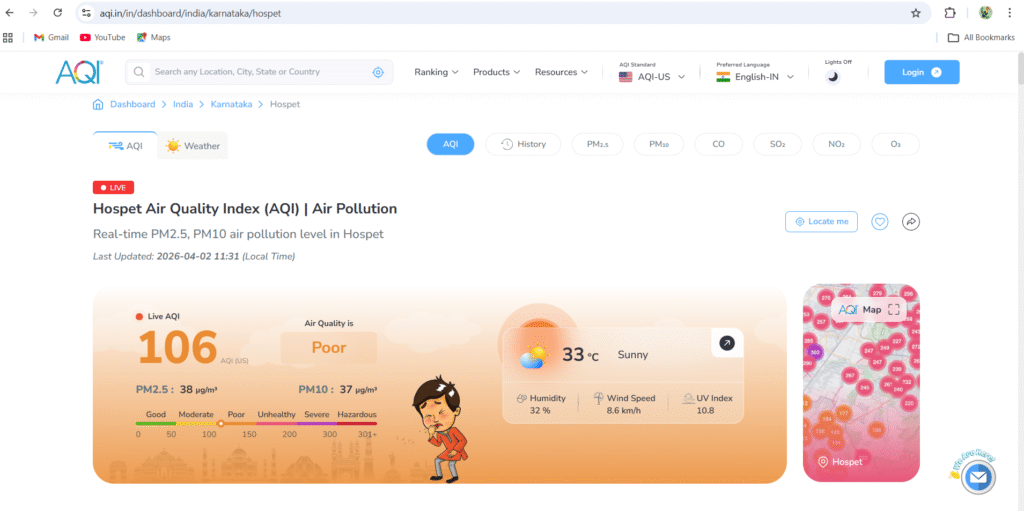
The AQI where I live is not that good it is worst as a male who spend more time outside it is very harmful for the skin
What concerns me most about these pollutants is their size. PM2.5 particles, for example, are roughly 20 times smaller than the diameter of a human hair. Research suggests that particles this small may actually penetrate the skin’s surface layers, disrupting normal cellular function and triggering a cascade of damaging reactions from within. That’s not just sitting on the surface that’s getting inside my skin.
Why My Oily Skin Is Especially Vulnerable

When I started understanding how men’s skin differs structurally and hormonally from women’s, I realized why I seem to be dealing with worse skin days than I’d expect. These differences become real liabilities when pollution enters the picture.
Higher sebum production: Testosterone stimulates my sebaceous glands to produce more oil than the average woman’s skin would. While sebum has some protective properties, in a polluted environment it acts almost like a magnet trapping fine particulate matter, heavy metals, and other airborne debris directly onto my skin and into my pores. My skin’s natural oil, which should theoretically be helping me, ends up working against me.
Larger pore size: Men generally have larger pores, which means more surface area for pollutants to settle into and deeper pathways for particles to travel as they accumulate throughout the day.
Thicker skin: Men’s skin is about 25% thicker than women’s due to higher collagen density. While this has some structural advantages, it also means that inflammation once triggered can be slower to resolve, and the effects of oxidative stress tend to build up over time without being immediately obvious.
Inconsistent skincare habits: I’ll be honest like most men, I wasn’t following a consistent skincare routine for years. That inconsistency meant pollutant buildup on my skin’s surface went unaddressed for longer periods than it should have, compounding the damage significantly over time.
The Pollution-Oily Skin Problem: Breaking It Down

1. The Sticky Film Problem
Here is where the real trouble starts for someone like me. Throughout the day, airborne pollutants settle onto my skin’s surface and mix with the excess sebum my skin naturally produces. This creates a dense, sticky film a combination of oil, sweat, and microscopic debris that coats my entire face.
This film doesn’t just sit harmlessly on the surface. It actively works its way into pores. As the day goes on, this mixture thickens, creating an increasingly hostile environment deep within the pore. The result is a significant increase in blackheads, whiteheads, and inflammatory acne a phenomenon researchers have begun calling “pollutacne.”
For someone who already struggles with oily skin and occasional breakouts, this pollution-driven congestion takes what might have been a manageable skin concern and escalates it into something far more persistent and frustrating. I started noticing this pattern myself my worst skin days were almost always after spending extended time outdoors in heavy traffic areas.
2. Free Radicals and Oxidative Stress
When pollutants land on or penetrate my skin, they generate free radicals unstable molecules that are missing an electron and aggressively seek to steal one from healthy skin cells. This process, known as oxidative stress, causes measurable damage to my skin’s structure at a cellular level.
For oily skin specifically, oxidative stress accelerates the breakdown of sebum into pro-inflammatory compounds. In other words, the excess oil that was already a concern becomes chemically transformed into something that actively worsens inflammation and skin damage. This can trigger or worsen acne lesions, increase redness, and leave the skin looking dull and congested even right after cleansing which I found deeply frustrating before I understood what was actually happening.
3. Pollution and My Dark Spots
One of my most persistent frustrations has been post-acne dark spots and uneven skin tone. What I’ve come to understand is that pollution may be making this significantly worse than it needs to be.
When my skin detects oxidative stress that alarm signal triggered by free radicals it mounts a defense response. Part of that response involves instructing melanocytes, the pigment-producing cells in the skin, to produce more melanin. The intention is protective, but the outcome can be counterproductive: uneven melanin distribution that clusters around areas of inflammation or congestion, creating dark spots and patches that linger long after the original breakout has healed.
In studies, this pollution-related pigmentation has been referred to as “urban melanosis,” and it tends to be especially visible on the face and other sun-exposed areas. For those of us with oily, acne-prone skin where inflammation is already frequent this cycle of breakout, inflammation, and pigmentation feels almost relentless without addressing the environmental trigger underneath it all.
4. My Skin Barrier Is Weaker Than I Thought
This was probably the most surprising thing I learned: having oily skin does not mean my skin barrier is strong. I always assumed the extra oil was a kind of natural protection. But frequent exposure to pollutants actually degrades the lipids the fatty molecules that hold skin cells together and maintain the barrier’s integrity, regardless of how much sebum the skin produces.
When my barrier is compromised, several damaging things happen at once. My skin loses moisture more rapidly, which paradoxically triggers my sebaceous glands to produce even more oil to compensate. Irritants and pollutants penetrate more easily. And my skin becomes generally more reactive, meaning even products or environments I previously tolerated well begin causing irritation.
This created a frustrating feedback loop I didn’t recognize for a long time: more pollution exposure weakened my barrier, a weaker barrier triggered more oil production, and more oil trapped more pollutants perpetuating the entire cycle.
My face after coming in contact with pollution

In the above image you can see the pimple above my eye brow this happens when i go in polluted area or pass in a road full of dust as i have oily skin the pollution sits on my face and the pimple will show up Always use a face mask or helmet that covers your entire face
Why listen to me

Written by sahil sheikh with 2 years of experience in men’s skin care niche
I have helped over 10 individuals in their skin problems like acne tanning recommending products and home remedies which worked for them very well
I have been helping my friends and sibling in their skin problem and by listening to me they have overcome their skin problem
This particular post was shared on quora and got 15 upvotes I usually share the information on Reddit and Quora about the men’s skin care
Building a Routine That Actually Works for Me
Understanding the problem finally gave me a clear roadmap for addressing it practically.
Cleansing Thoroughly But Not Aggressively
Cleansing became my number one priority. The goal is removing the daily buildup of pollutants, excess sebum, and debris without stripping my skin so aggressively that I trigger rebound oil production which I had been doing for years with harsh face washes.
I now follow a double-cleansing approach in the evening: starting with a micellar water or gentle oil-based cleanser to dissolve the surface film, then following with a gentle foaming gel cleanser suited to oily skin. In the morning, a single gentle cleanse is usually enough.
Layering in Antioxidants
Antioxidants became my primary weapon against free radical damage. I look for lightweight serums containing:
- Vitamin C : to neutralize free radicals and help fade those stubborn dark spots
- Niacinamide: a genuine multitasker that helps regulate my sebum production, strengthens my barrier, calms inflammation, and visibly reduces dark spots over time
- Vitamin E : used alongside Vitamin C to boost its overall effectiveness
For oily skin, water-based or gel-format serums work far better than anything heavy or oil-rich.
Moisturizing Even With Oily Skin
Skipping moisturizer was one of my biggest mistakes for years. A lightweight, non-comedogenic moisturizer with ceramides or hyaluronic acid helps reinforce my skin barrier and reduces my skin’s compulsion to overproduce oil as compensation.
Never Skipping Sunscreen
UV radiation compounds the damage caused by pollution significantly, generating its own wave of free radicals. A broad-spectrum SPF 30 or higher every morning has become non-negotiable for me. Gel or fluid textures suit my oily skin best without adding congestion.
Spray vs Lotion vs Stick Sunscreen: Which One Should You Choose?
Updated on : April 2, 2026 Written by : sahil sheikh
Final thought
Living with oily skin in a polluted urban environment is genuinely tough. My excess sebum acts as a pollutant trap, my larger pores provide easier entry points for microscopic particles, and my previously inconsistent skincare habits allowed damage to quietly accumulate over time. The result was a compounding cycle of congestion, inflammation, breakouts, and pigmentation that felt relentless because without addressing the environmental trigger, it essentially was.
But understanding the mechanism behind this damage changed everything for me. Consistent cleansing, targeted antioxidant support, barrier protection, and daily sun protection form the foundation of a routine that can meaningfully reduce pollution’s impact on the skin.
For anyone dealing with persistent acne, significant pigmentation, or unusual sensitivity, I’d strongly encourage consulting a board-certified dermatologist for personalized diagnosis and treatment. Understanding your environment is a great start but professional guidance makes all the difference